Honour and etiquette code
Lazarillo de TormesThe Honour and etiquette code governs how rank is displayed and acknowledged through dress, posture, titles, greetings, and deference. In the novel it is most sharply embodied by the impoverished squire, whose insistence on the forms of aristocratic dignity persists even as he depends on Lázaro’s begging for food. The code’s theatrical authority is set against material want, and the adult Lázaro’s response to rumors about his marriage shows that reputation remains consequential even when it is accommodated to practical advantage.
Rank Made Visible
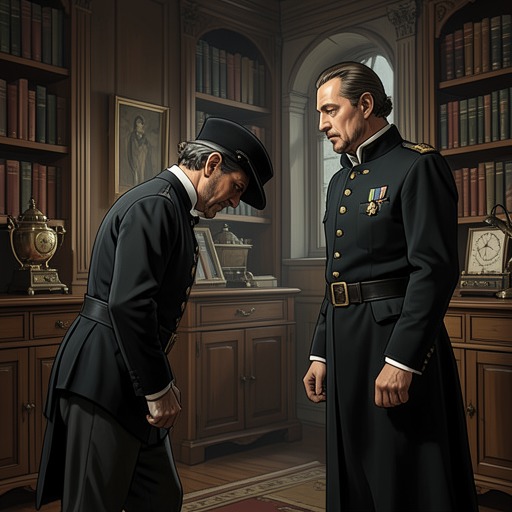
The squire belongs to a historically grounded class of hidalgos, real or self-proclaimed, whose noble status brought exemption from taxes but also imposed expectations of maintaining an appropriate social and economic standing. His appearance is part of that claim: he walks erect and tends excessively to his clothing and person so that people of lower rank will recognize him. His insistence on the proper forms of respect thus has a public function. Rank must be made legible in everyday encounters, not merely asserted in private.
The code is also a hierarchy of speech. The squire rejects an artisan’s greeting of “Dio vi protegga” as too ordinary for a man of his quality, insisting that a person of lower condition should use that form while a gentleman should say “Bacio le mani a Vostra Signoria” or, at minimum, “Vi bacio, signore, le mani.” Lázaro questions why a blessing should count as bad manners, but the squire treats the choice of greeting as a measure of whether the speaker has recognized his station. Courtesy, in this world, is not simply kindness; it is a ritual allocation of social distance.
The Squire’s Performance and Poverty
The squire explains that he left Castilla la Vieja because he resented repeatedly removing his hat first for a local knight. Although the knight was richer and of higher rank, the squire believes that his own repeated gestures of deference should have been reciprocated. He presents the dispute as a matter of honour rather than convenience, and generalizes from it to a rule of conduct: a hidalgo must preserve his own dignity and avoid situations that might require him to yield it. He says he would duck into a house or take another route rather than remove his hat to a count who failed to remove his own sufficiently.
His account of an artisan makes the code’s pettiness still more explicit. When the man repeatedly wished him God’s protection, the squire rebuked him for failing to address him as a superior. Afterward, the artisan removed his cap and spoke as required. The ritual succeeds in producing outward deference, but the scene does not establish that the squire possesses the wealth or power his manner claims. Instead, it reveals how status can be performed and socially enforced through ordinary forms of address.
The gap between this performance and the squire’s circumstances is decisive. He claims that he is not truly poor because he owns a building plot near Valladolid and a dovecote, but the plot is valuable only in the imagined condition that houses have been built on it, and the dovecote is in ruins. He has left his home in search of a suitable position and complains that the available employers are either miserly or too low in standing. Meanwhile, he accepts the food Lázaro obtains by begging. The novel makes the contradiction concrete: the man who will not compromise a greeting or a hat depends on a child’s alms to eat.
A Failed Lesson in Honour
The first three masters mark successive stages in Lázaro’s formation. The blind man is his declared teacher; the miserly priest teaches indirectly by obstructing him and compelling him to devise means of survival. The squire is a failed teacher: what he can offer is a hollow code of honra, grounded in reputation and social dignity but detached from material substance. His example does not make Lázaro into a defender of noble etiquette. Rather, it exposes the cost and absurdity of a social ideal that demands the appearance of means from someone who lacks them.
The squire is not rendered simply as a target of contempt. Lázaro regards him with pity, distinguishing his condition from that of masters who possessed money yet starved their servant. He says that he would rather serve this poor man than the blind man or the priest, while wishing the squire were less proud given his miserable circumstances. That compassion complicates the satire: the squire’s vanity is real, but so is his poverty, and his attachment to the code is presented as a fixed social rule rather than an isolated eccentricity. His gentleness toward Lázaro when he briefly has money, and when the frightened boy takes refuge in the house, further makes him pathetic as well as ridiculous.
The code also marks a transition in the protagonist’s independence. The first three masters seek out Lázaro and draw him into subordinate relations. Later, the grown Lázaro increasingly seeks work himself or encounters a master by chance; from the sixth tratado onward, his relations are no longer simply master and servant but paid employment. He receives money rather than only the occasional crust of bread, though the occupations remain among the most degrading in that society. The squire’s lessons in honour therefore stand at an early point in a larger movement: Lázaro learns not to adopt the code, but to navigate a society in which appearances and rank still shape the terms of survival.
Reputation at the Ending
The narrative’s frame gives honour a second, more compromising form. Lázaro addresses a powerful superior as “Vostra Signoria,” explaining that he has written from the beginning of his life because he was asked to give a full account of the caso. He presents his adversity as proof of what a person of low birth can achieve through effort, while the letter’s final disclosure connects that explanation to his present position. The polished claim to worldly success therefore belongs to a self-defense addressed upward, not to a detached account of honour.
As an adult, Lázaro accepts the archpriest of San Salvador’s proposal that he marry the archpriest’s servant. The archpriest gives the couple grain, meat on religious feast days, occasional offerings of bread, used clothing, a small house near his own, and frequent meals. Those benefits support the household, but they coexist with rumors that Lázaro’s wife goes to the archpriest’s house to make his bed or prepare his food. The arrangement that secures material stability thus exposes Lázaro’s reputation to public judgment.
Lázaro answers the rumors by insisting that his wife is the best woman in Toledo and threatening anyone who claims otherwise. He declares that he loves her more than himself, yet he also tells her she may come and go as she pleases and promises never again to raise the matter. The archpriest has already advised him not to heed malicious talk and to attend to what is advantageous. In this ending, honour is neither simply upheld nor openly discarded: Lázaro suppresses discussion of the “caso,” protects the arrangement on which his household depends, and presents the result as prosperity. The same social world that made the squire cling to an empty appearance now finds Lázaro maintaining domestic peace through a calculated refusal to confront what the rumors imply.